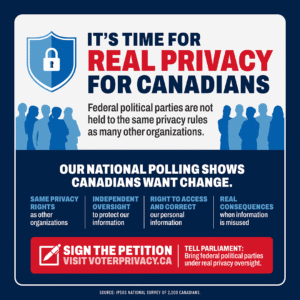
May 1, 2026 – BC Freedom of Information and Privacy Association (FIPA) recently had the opportunity to make a submission to the Standing Committee on Procedure and House Affairs (PROC) regarding the Government of Canada’s proposal of Bill C-25. We have a lot to say about how political parties use personal information including a Commentary on how Information misuse puts you at risk, our involvement in www.voterprivacy.ca and as we encourage people to sign House of Commons Petition E-7237. The following submission was drafted by Ryan Rutley and Pascale Grenier and submitted to the committee.
Bill C-25, otherwise known as the Strong and Free Elections Act, has been introduced to amend the Canada Elections Act. In Canada, federal political parties are not subject to the same privacy legal regimes as public bodies or other private organizations such as corporations when it comes to managing the personal information of voters. Bill C-25 expands privacy regulation over political parties, but not to the extent necessary to adequately protect the public’s sensitive information.
What does Bill C-25 do? It builds off Bill C-4, another recent amendment to the Canada Elections Act which exempts federal political parties from provincial and territorial privacy laws. Bill C-25 is designed to impose requirements on political parties regarding their internal privacy policies. It requires them to implement regulations which increase safeguards around sensitive information, establish procedures in the face of breaches, and prohibit the sale of voter information. However, Bill C-25 is lacking key provisions to protect privacy in several substantial ways.
Specifically, Bill C-25 makes political parties answerable to internal policies, meaning they draft and enforce the policies themselves, as opposed to being subject to an external statutory framework. There is no requirement for parties to provide voters with the means to access or alter information held by the party, no system of complaint processing, nor is there an independent oversight body which specifically monitors parties’ compliance with their internal policies. Furthermore, under Bill C-25, parties are only obligated to inform voters of a breach if there is a “real risk of significant harm.” Due to the sensitive nature of the information they hold, this threshold is too high.
FIPA is concerned with the lack of independent oversight within the framework of C-25. The lack of accountability mechanisms is inconsistent with current legal regimes for bodies other than political parties. Its recommendations center around a desire for more concrete legal duties which can be independently monitored and a robust complaint and access regime which enforces transparency. It argues for stronger limitations regarding the sharing of data and a lower threshold for when individuals should be informed of a breach.
Voter information is highly sensitive. It may contain an individual’s political views, their demographic characteristics, and even data on past contributions. That this information be protected from potential misuse is vital to a functioning democracy. The objectives of Bill C-25 align with a strong democracy, but in practice the framework falls short of delivering the privacy protection Canadian voters expect and deserve.
FIPA is appreciative of the opportunity to provide this submission in furtherance of its goals of fostering free access to information and the protection of privacy. FIPA continues to promote these values in its advocacy across Canada.
You help us fulfill our mandate and stay independent. Every contribution – big, small, one-time, or recurring – makes a difference. Click here to donate.