
BC Freedom of Information and Privacy Association
Your Data Your Rights

FIPA is an ICLMG member and republishes this content with permission.
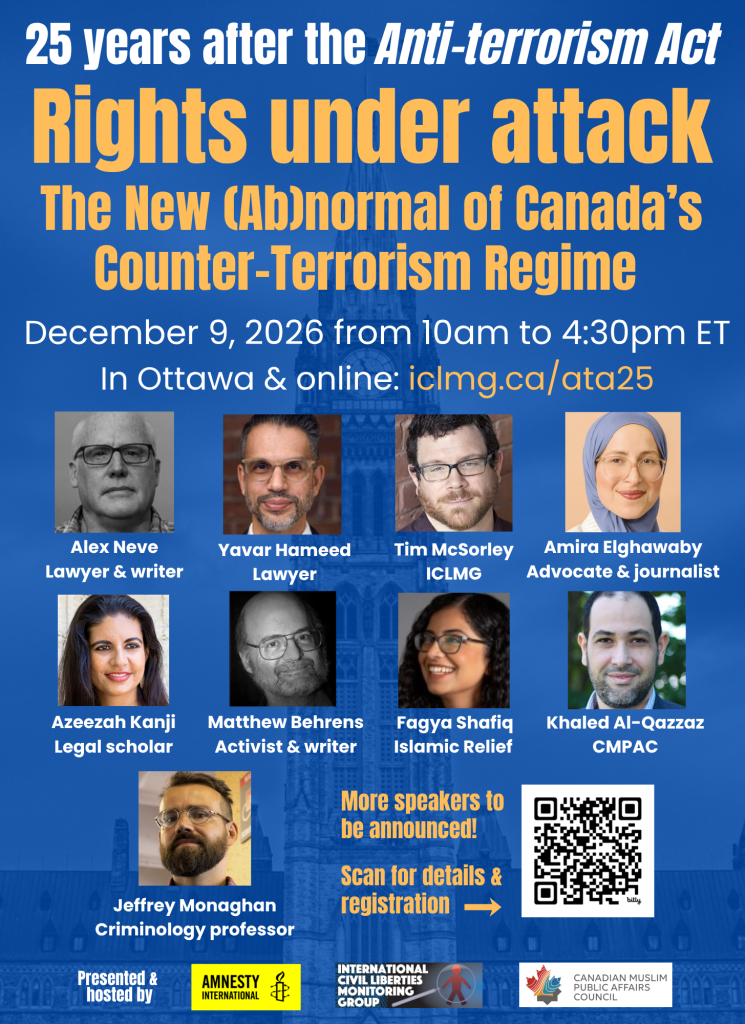
Date: December 9, 2026, 10am to 4:30pm ET
Where: Amnesty International Canada in Ottawa & via Zoom
Featuring three panels, with lunch included. Free but registration required.
Attend in person
(Register before Dec 2nd. Space is limited)
Event description
December 18, 2026, marks the 25th anniversary of the adoption of Canada’s first Anti-terrorism Act (ATA). Introduced and adopted over a period of just two months following the attacks of Sept. 11, 2001 – with minimal debate or scrutiny – the legislation enacted sweeping changes to Canadian national security law. These changes set the stage for policing, surveillance, judicial and immigration policies, among others, for the decades to come.
The impacts have ranged from the seemingly banal – removing shoes and emptying water bottles at the airport – to some of the gravest human rights and civil liberties violations imaginable, including rendition to abuse and torture, hardening of borders and restrictions on migration and asylum, rising xenophobia, racism and Islamophobia, limits on freedom of expression and assembly, the criminalization of dissidents, such as Indigenous land defenders and Palestinian solidarity activists, sweeping surveillance measures and the erosion of privacy, the proliferation of secretive terrorism watch lists and the growing use of secret evidence in courts. It also includes the ever-growing and broadening application of these powers under the guise of fighting “terrorism” or protecting “national security,” in Canada and around the world.
How does this “new normal” continue to impact civil liberties and human rights today? What lessons can we learn from the fight against the negative impacts of anti-terrorism laws over the past 25 years? Join us on Dec. 9 to explore these questions over the course of three panels about the impacts on the law, media, and civil society.
Schedule
Panel description and speakers
Panel 1: The ATA and the law
The ATA made sweeping changes to Canadian law, and has been followed over the last 25 years by anti-terrorism and national security bills that continue to expand its scope. Together, they have implemented broad definitions of terrorism, imposed secret watch lists, expanded surveillance powers, and introduced other measures that have undermined and continue to threaten Charter-protected freedoms. 25 years later, what is the ongoing legacy on the justice and legal system?
Moderator: Alex Neve, lawyer, professor, writer, former Secretary-General for Amnesty International Canada
Speakers:
- Yavar Hameed, lawyer
- Azeezah Kanji, legal scholar and writer
More to be announced
Panel 2: The ATA and the media:
How has the legacy of the Anti-terrorism Act and national security laws in general impacted reporting, and how has Canada’s role in the “war on terror” shaped media narratives over the past 25 years, including who is seen as a terrorist threat, who is not, and whose voices get centred?
Moderator: TBA
Speakers:
- Amira Elghawaby, advocate, journalist and former Special Representative on Combatting Islamophobia of Canada
-
Jeffrey Monaghan, Associate Professor, Institute of Criminology and Criminal Justice
More to be announced
Panel 3: The ATA and civil society
The impacts of the ATA do not land evenly. Muslim, Indigenous, migrant, refugee and racialized communities, among others, have borne the brunt of the anti-terrorism regime. How has civil society pushed back? What are the ongoing threats, and how do we organize together?
Moderator: Tim McSorley, National Coordinator, International Civil Liberties Monitoring Group
Speakers:
- Matthew Behrens, activist and writer
- Khaled Al-Qazzaz, Executive Director, Canadian Muslim Public Affairs Council (CMPAC)
- Faghya Shafiq, Chief Financial Officer, Islamic Relief Canada
More to be announced
The post 25 years after the Anti-terrorism Act: Rights under attack! appeared first on International Civil Liberties Monitoring Group.
This post was originally published on ICLMG
You can support trusted and verified content like this.
FIPA's news monitor subscribers, donors and funders help us to bring this all together. We appreciate every contribution because it makes a difference.
If you found this interesting and useful, please consider contributing here.

Learn more about our News Monitoring here.
Categories
ICLMG