
BC Freedom of Information and Privacy Association
Your Data Your Rights

FIPA is an ICLMG member and republishes this content with permission.
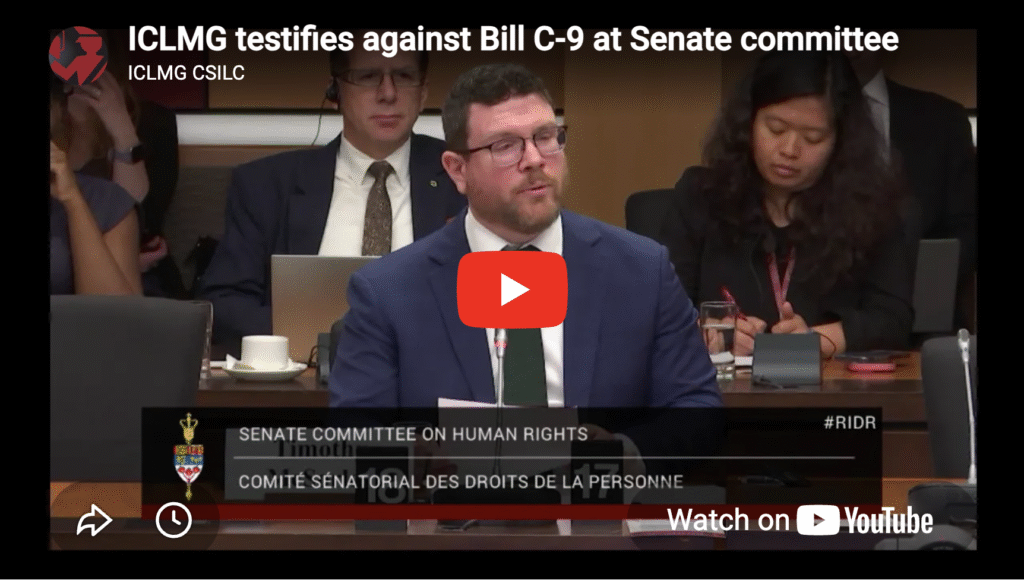
On May 20, 2026, the ICLMG testified against Bill C-9, the “Combatting Hate” Act, at the Standing Senate Committee on Human Rights. Although it is aimed at preventing hate crimes, the bill instead threatens the Charter rights and civil liberties of all people in Canada – specifically our freedom of expression and assembly – including those communities that the government wishes to help protect.
Watch the short intervention above or read the transcript below. For the full Senate meeting, or to select the French audio and/or subtitles, go to 13:18:15 here.
For more details on why the bill is so problematic and must be quashed, read our full brief to the Senate committee.
Finally, please take action below to urge the Senate committee to oppose Bill C-9; and share widely. Thank you!
TESTIMONY TRANSCRIPT
Thank you for the invitation to appear today.
I am here on behalf of the International Civil Liberties Monitoring Group — a coalition of 45 Canadian organizations. ICLMG was founded in 2002 to serve as a watchdog on the impacts of Canada’s national security and anti-terrorism laws on civil liberties.
Our coalition has observed with distress the increase in hate-based violence across Canada over the past several years. We believe greater measures must be taken to address it. But such measures must be targeted and specific, and must not unduly impact civil liberties or Charter rights — including those of the very communities the measures are meant to protect.
Unfortunately, several measures in Bill C-9 fail that test. We share the concerns of 37 signatories of an open letter, led by the Canadian Civil Liberties Association, that identified substantial problems in the bill and called for it to be withdrawn.
Today I would like to focus on one area: the provisions in Clause 4 that would create a new offence of wilfully promoting hatred by displaying certain symbols in public. These provisions pose a significant threat to freedom of expression — by granting broad and discretionary powers to police, and by basing the determination of which symbols are included on a flawed terrorist listing process. They are also redundant.
The new offence states, in part: “Everyone commits an offence who wilfully promotes hatred against any identifiable group by displaying, in any public place: a symbol principally used by or associated with a listed terrorist entity; the Nazi Hakenkreuz or SS bolts; or a symbol that so nearly resembles one of those that it is likely to be mistaken for one.”
The government has stated that simple display of an impugned symbol would not violate the law without additional evidence of intent. However, this is not clear from the drafting. Instead, the plain reading would be that the simple public display would be considered wilful promotion of hatred — going further than existing anti-terrorism law, which does not treat the mere display of a symbol associated with a terrorist entity as an offence, precisely because doing so would violate the Charter.
If the government’s intent is that the offence requires display in the context of wilfully promoting hatred, the bill must be amended — at minimum, by changing “by” to “while.” But even with such a change, we do not believe this offence should be adopted.
The wilful promotion of hatred is already a Criminal Code offence under section 319(2), and the government has confirmed this includes the use of symbols as part of a pattern of evidence. It is difficult to see why a new offence is necessary. Focusing on symbols used, rather than intent, risks chilling free expression.
This brings us to our third concern: vagueness. The wording asks police officers to make discretionary, on-the-spot determinations of what constitutes a symbol “associated with” or “used by” any of the 90 listed terrorist entities — which we understand could include words and slogans.
A clear example is the ongoing dispute over whether symbols associated with Palestinian human rights protests are hateful or terrorist-linked. Already, there are calls for police to make more arrests at protests on the grounds that symbols in support of Palestinian self-determination are associated with terrorist entities. Under this legislation, police would be further called upon to determine, mid-protest, not only whether a symbol is associated with a listed entity, but whether it is being used to wilfully promote hatred, and whether it sufficiently “resembles” a prohibited symbol. Would Arabic writing or certain colours on a sign be enough to arrest someone if an officer believes it resembles imagery associated with a listed entity?
This would apply across all listed entities and could affect protests from a broad range of communities — raising serious concerns about guilt by association and the stigmatization of entire movements. These problems could also be compounded as the Terrorist Entities List continues to expand under future governments — including, for example, through growing calls to list anti-fascist organizations as terrorist entities.
Given the severe potential for overreach, and the stigma attached to a hate crime accusation, we believe this provision will create an unacceptable chill on free expression and dissent.
Finally, basing criminal offences on the Terrorist Entities List is itself unacceptable. Listings rely on secret evidence and unaccountable executive decisions, with inadequate avenues for challenge or redress, and can be political in nature. New criminal offences should never be built on such a foundation.
This is one of many concerns with Bill C-9 — including the proposed intimidation and obstruction offences, and the removal of the good faith religious defence. We believe the bill should be withdrawn and the government’s approach revisited. We urge you and your Senate colleagues to act to address these concerns, and I look forward to your questions.
The post ICLMG testifies against Bill C-9 at Senate committee appeared first on International Civil Liberties Monitoring Group.
This post was originally published on ICLMG
You can support trusted and verified content like this.
FIPA's news monitor subscribers, donors and funders help us to bring this all together. We appreciate every contribution because it makes a difference.
If you found this interesting and useful, please consider contributing here.

Learn more about our News Monitoring here.
Categories
ICLMG