
BC Freedom of Information and Privacy Association
Your Data Your Rights

FIPA is an ICLMG member and republishes this content with permission.
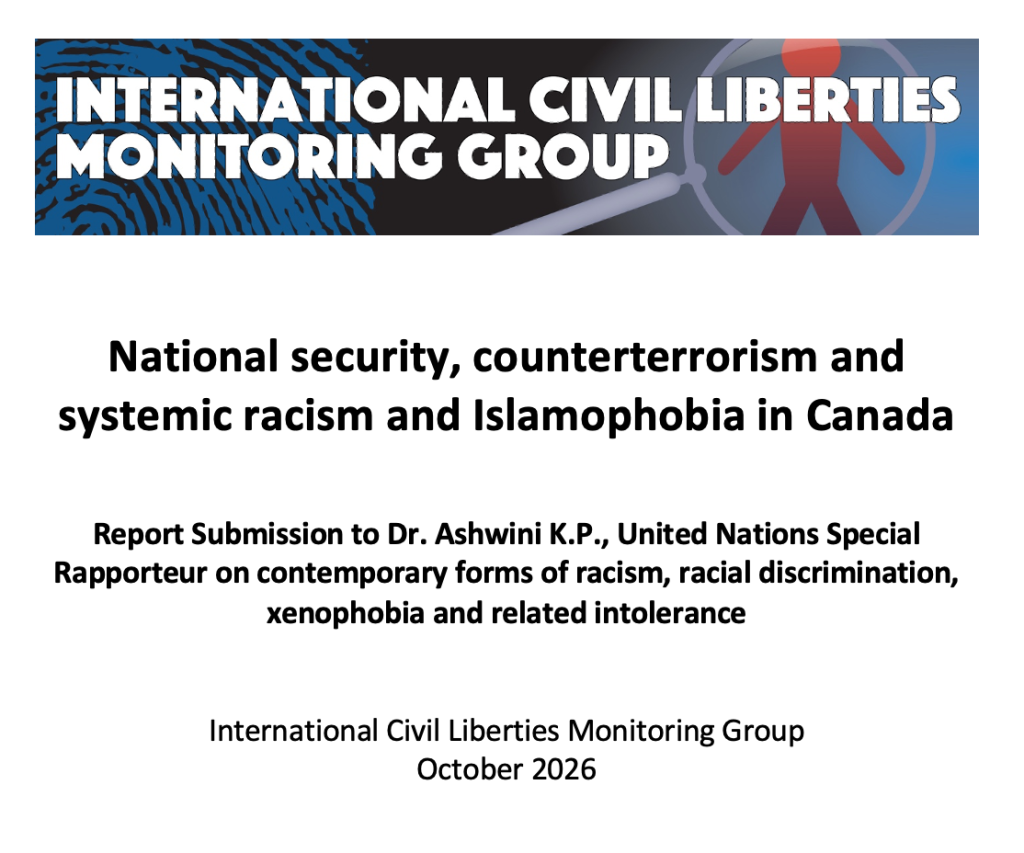
In late September, the UN Special Rapporteur on contemporary forms of racism, racial discrimination, xenophobia and related intolerance, Dr. Ashwini K.P., visited Canada to meet with stakeholders and government officials to evaluate how Canada’s efforts to counter racial discrimination. ICLMG had the opportunity to meet with Dr. Ashwini along with other non-governmental organizations, activists and academics to share our analysis. Following the meeting, we submitted a brief for the Special Rapporteur’s study, which will result in a full report delivered at the 65th session of the Human Rights Council in June 2027.
Below is an excerpt, a summary of our recommendations and a link to the full report.
National security, counterterrorism and systemic racism and Islamophobia in Canada
As a broad-based coalition deeply concerned by the impacts of all forms of hate and racism in Canada, we are pleased to submit this brief to the UN Special Rapporteur on contemporary forms of racism, racial discrimination, xenophobia and related intolerance regarding the impacts of Canada’s anti-terrorism and national security laws.
Our coalition’s focus is on the impacts of national security and anti-terrorism laws in Canada, and our country’s role and actions post 9/11, throughout the so-called War on Terror, and the evolving views on terrorism, extremism and violence today.
We have documented, criticized and proposed solutions to the negative impacts that these laws have had on freedom of speech, association, religion and movement; on privacy; on levels of government surveillance; on the rule of law; on due process and access to justice; and on equality rights.
Throughout all this, we have also seen a deeply problematic and consistent problem of racial, religious and political profiling, abetted by the vague and overreaching definitions of terrorism and national security. Central to this has been the targeting of Muslims, Arabs, and those perceived to be Muslim, although it has also deeply impacted other communities, most notably Indigenous peoples as well as environmental and climate activists.
This undue focus on the so-called “Islamist” threat, espoused even by a former prime minister as being the “greatest” threat to Canada, has led to more than two decades of state-sanctioned, systemic racism against Muslims and other racialized communities in Canada.
Much needs to be done to address individual acts of hatred and Islamophobia; however, the role of state systemic Islamophobia must also be clearly and immediately addressed. And while the response to “individual” vs. “systemic” Islamophobia may take different shapes, it is crucial to recognize how one supports the other. Decades of government agencies and officials framing Muslims in Canada and internationally as being the most direct threat to national security – despite a lack of evidence demonstrating that threat, and in ignorance of other more direct threats such as the horrific treatment of Indigenous peoples, the threat of climate change, and increasingly the threat of white supremacist violence – have fed the fears of the public, causing individuals to view their Muslim neighbours and colleagues with fear and suspicion.[1]
Over the past two decades, studies by academics and civil liberties organizations have repeatedly documented the disproportionate impact of national security measures on Muslim communities. Laws like the Anti-Terrorism Act, 2015[2] and the National Security Act, 2017[3] have expanded national security powers without adequate transparency and oversight, disproportionately threatening the fundamental rights and freedoms of communities across Canada. While Muslim communities have faced some of the most direct impacts, the intersection of municipal and provincial policing, federal policing and intelligence agencies means that the impacts have been felt more widely, including the growing use of facial recognition and other algorithmic policing tools that are known to be biased against people with darker skin tones, and especially Black and Indigenous women; the framing of South Asian and Indian migrants, among others, are either national security or terrorist threats; the use of national security measures to criminalize and repress Indigenous land defenders; and the targeting of Palestinians, especially those advocating against the genocide and for Palestinian self-determination and human rights as terrorist threats.
In our report we identify several areas of concern that require urgent action that we hope will assist in the Special Rapporteur’s research and upcoming report on Canada. Below you’ll find our recommendations for each area of concern. To read the full report, click here.
Areas of concern and recommendations
1. Surveillance and algorithmic policing
Recommendations:
- That Canada adopt transparent, rigorous and independent human rights evaluation of new surveillance and algorithmic policing tools before adoption
- That Canada review national security and counter-terrorism legislation through an anti-racist, intersectional and anti-oppressive lens
- That Canadian law enforcement and intelligence agencies end their targeted surveillance of racialized communities
2. Civil society organizations and NPOs
Recommendations:
- That the Ministry of Finance revisit the anti-terror regulatory, policy and legislative landscape, particularly the 2015, 22023 and 2025 National Risk Assessments and their impacts, particularly on the Muslim community.
- That the Minister of National Revenue declare an immediate moratorium on the targeted audit of Muslim charities by the CRA RAD until such a review is completed and legislative changes put in place
- Integrate civil liberties and financial inclusion impact analyses into National Risk Assessments (NRA).
- Issue policy guidance to relevant departments and bodies on de-risking and financial inclusion, including reporting requirements.
- Amend the PCMLTFAto require reporting entities to report annually on de-risking, including volumes and rationale.
- Amend the PCMLTFAto clarify that failing to safeguard against disproportionate de-risking constitutes a compliance failure.
- Develop training on risk-based decision-making regarding the NPO sector, including systemic bias and discrimination.
- Allow independent review of financial institutions’ risk-based decision-making in complaint investigations.
3. Border controls
Recommendations:
- That Canada establish an independent complaints and review body for the Canada Boder Services Agency
- That Canada amend the provisions of the Strengthening Canada’s Immigration System and Borders Act to prevent discretionary decision-making, protect privacy and uphold the rights of refugees
- That Canada withdraw the immigration security certificates against Mr. Harkat and Mr. Mahjoub, and repeal the security certificate system
- That Canada abolish its secretive, discriminatory No Fly List regime
4. Terrorist Entities Listing
Recommendation:
- Canada should rescind the Terrorist Entities Listing process in favour of transparent, targeted sanctions.
5. Canadian complicity is detention, mistreatment and torture abroad
Recommendations:
- Resolve the case of Abousfian Abdelrazik and apologize for the Canadian government’s role in his mistreatment.
- Take action to safely repatriate all Canadians currently detained in Northeastern Syria and Iraq.
- Commit to no new extradition of Dr. Diab to France.
6. Dissent and free expression
Recommendations:
- Canada must stop considering all Palestinians as potential security threats, welcome the Gazan families of Palestinian Canadians accepted through the “emergency” program, and reopen the program to process more applications to save more lives before it’s too late.
- The federal government must ensure law enforcement and intelligence agencies halt their targeted surveillance and criminalization of Muslim, Palestinians and their allies.
- Canada must significantly amend the Combatting Hate Act to remove provisions that impinge on freedom of expression and assembly, and that can be used in discriminatory, arbitrary ways.
7. Combatting hate online
Recommendations:
- Remove the definition of content that incites terrorism or violent extremism from Bill C-34, the Safe Social Media Act.
- Ensure a clear and effective redress mechanism for instances when social media platforms engage in overcompliance/censorship as a result of online harms regulations.
8. Review and accountability
Recommendation:
- That the federal government restore funding cuts to NSICOP, NSIRA and IC, and engage in consultations to increase their funding to be commensurate with their work to oversee Canada’s national security regime.
[1] “Islamophobia in Canada: Submission to the UN Special Rapporteur on Freedom of Religion or Belief” (30 Nov. 2020) International Civil Liberties Monitoring Group, Islamic Social Services Association, and Noor Cultural Centre. Online: https://www.ohchr.org/Documents/Issues/Religion/Islamophobia-AntiMuslim/Civil%20Society%20or%20Individuals/Noor-ICLMG-ISSA.pdf
[2] Anti-terrorism Act, 2015 (S.C. 2015, c. 20), https://laws.justice.gc.ca/PDF/2015_20.pdf
[3] National Security Act, 2017 (S.C. 2019, c. 13), https://laws-lois.justice.gc.ca/eng/acts/N-16.56/
The post Submission to UN Special Rapporteur: National security, counterterrorism and systemic racism and Islamophobia in Canada appeared first on International Civil Liberties Monitoring Group.
This post was originally published on ICLMG
You can support trusted and verified content like this.
FIPA's news monitor subscribers, donors and funders help us to bring this all together. We appreciate every contribution because it makes a difference.
If you found this interesting and useful, please consider contributing here.

Learn more about our News Monitoring here.
Categories
ICLMG