New Alberta Poll: Albertans Want Privacy Law to Protect Voter Information from Political Misuse
FIPA-Ipsos polling finds Albertans reject political-party self-regulation and support enforceable privacy rules, shared oversight, and fair information principles.
Victoria, B.C. June 3, 2026 — A new Ipsos poll conducted on behalf of the BC Freedom of Information and Privacy Association (FIPA) finds that Albertans want enforceable privacy protections for voter information collected, used, shared, or retained by political parties, candidates, campaign organizations, and their agents.
The Alberta poll of 801 adult residents was conducted between May 22 and 26, 2026, following Elections Alberta’s statement that there had been alleged unauthorized use and distribution of the provincial List of Electors. The results show that the public expectation is clear: voter information should not lose privacy protection once it enters the political system.
Read: Albertans Want Better Safeguards for Voter Information
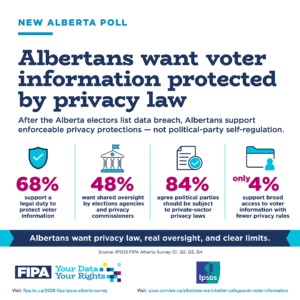
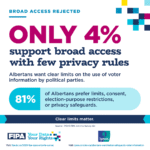
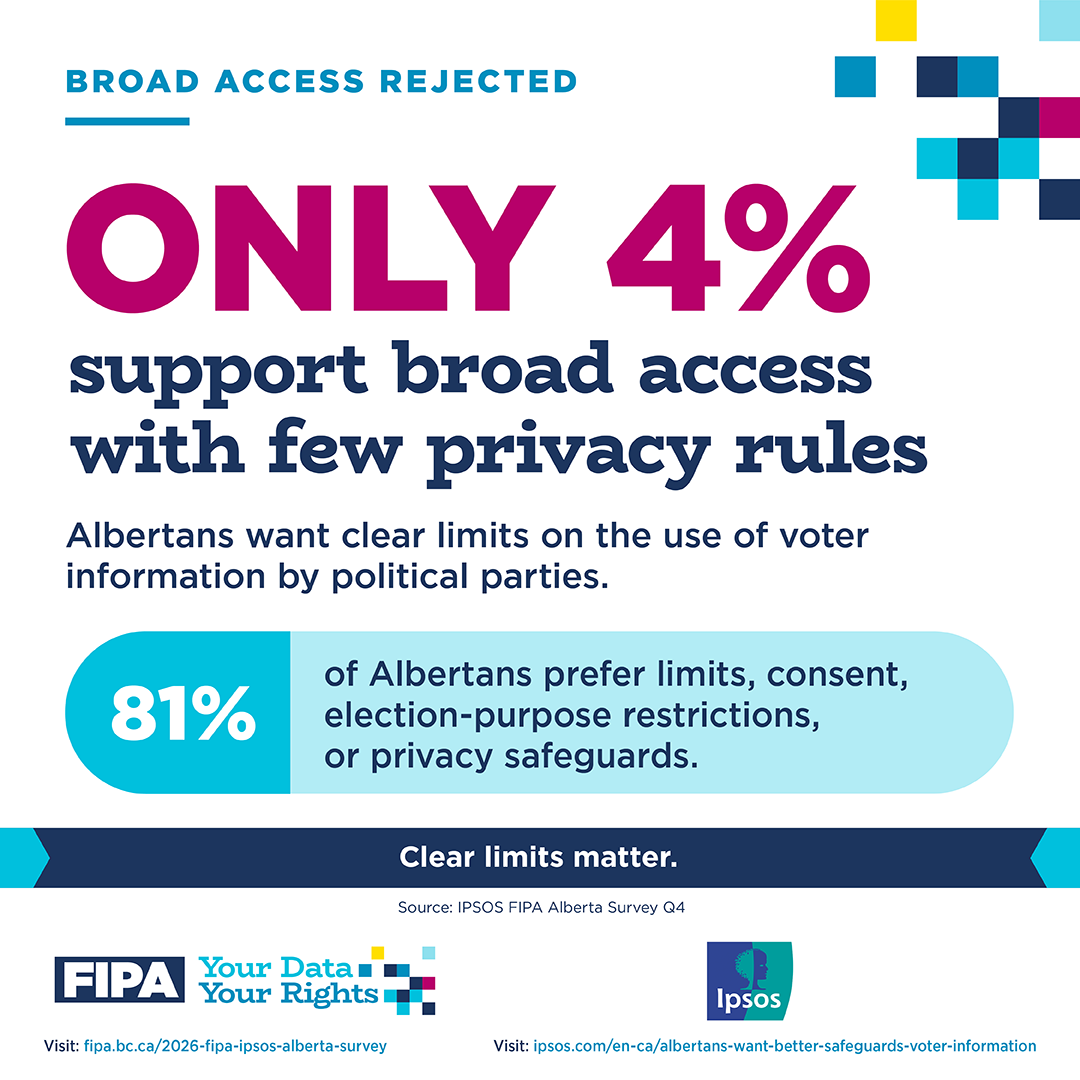
Only 4% of Albertans choose broad political access to voter information with fewer privacy rules as their preferred balance. By contrast, 81% choose a model with defined limits, consent, election-purpose restrictions, or privacy safeguards.
“Albertans understand that political communication is part of democracy,” said Jason Woywada, Executive Director of FIPA. “But they do not accept the idea that political parties should get weaker privacy rules because the information is being used for political purposes. The message from this poll is clear: voter information should be protected by enforceable privacy law that involves the Privacy Commissioner and Elections Alberta.”
“These findings are not ambiguous. Albertans support fair information principles, privacy-law application, access rights, correction rights, breach notification, penalties, and independent oversight. They do not support political parties writing and enforcing their own privacy rules.” — Mike Larsen, President, FIPA
“The Alberta breach is a provincial warning with national consequences. If voter information can move through political systems without clear privacy rights, independent oversight, and enforceable rules, the same risks can appear anywhere in Canada.” — Jason Woywada, Executive Director, FIPA
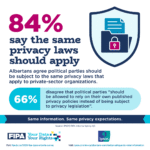
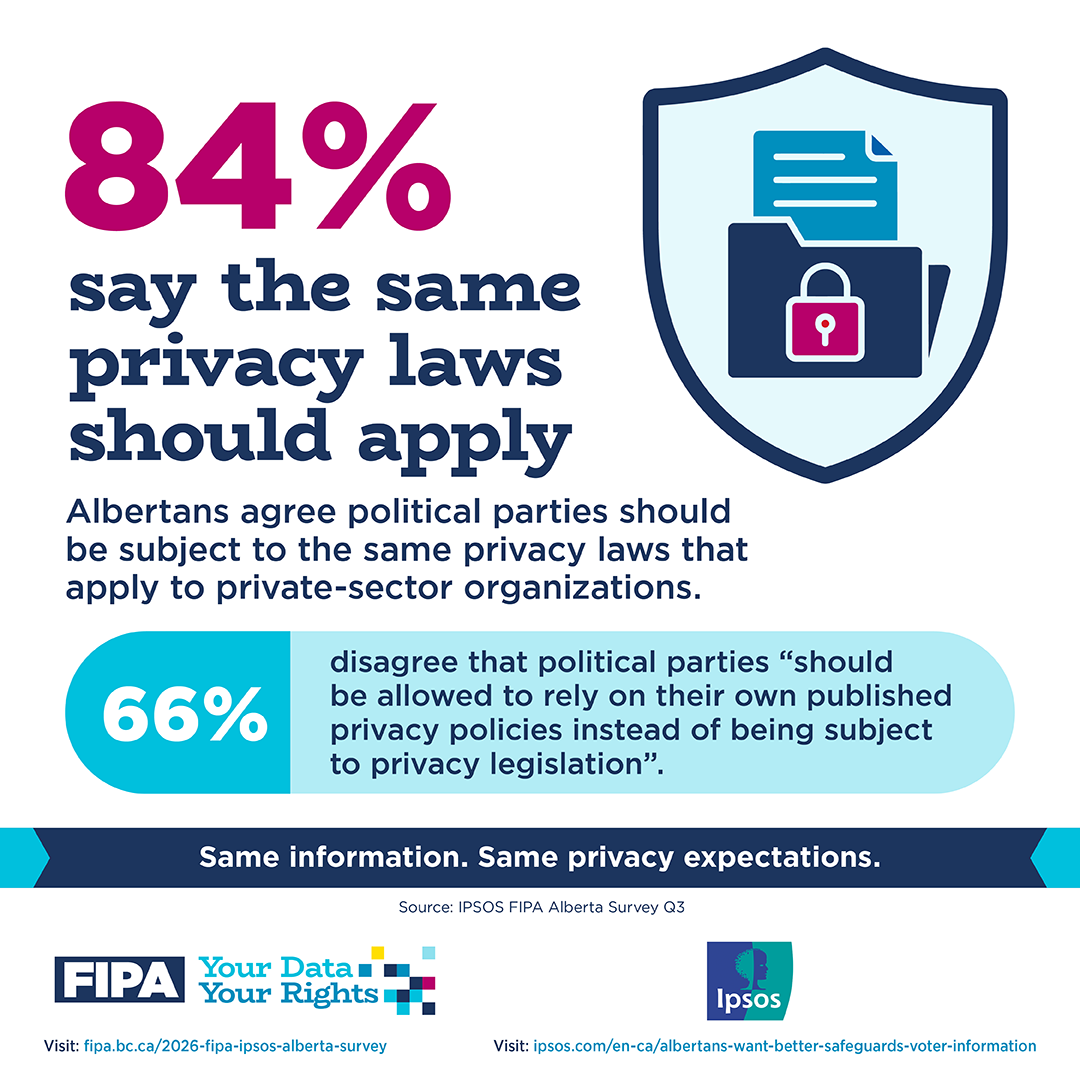
Political actors should be subject to the same private-sector privacy laws as other organizations.
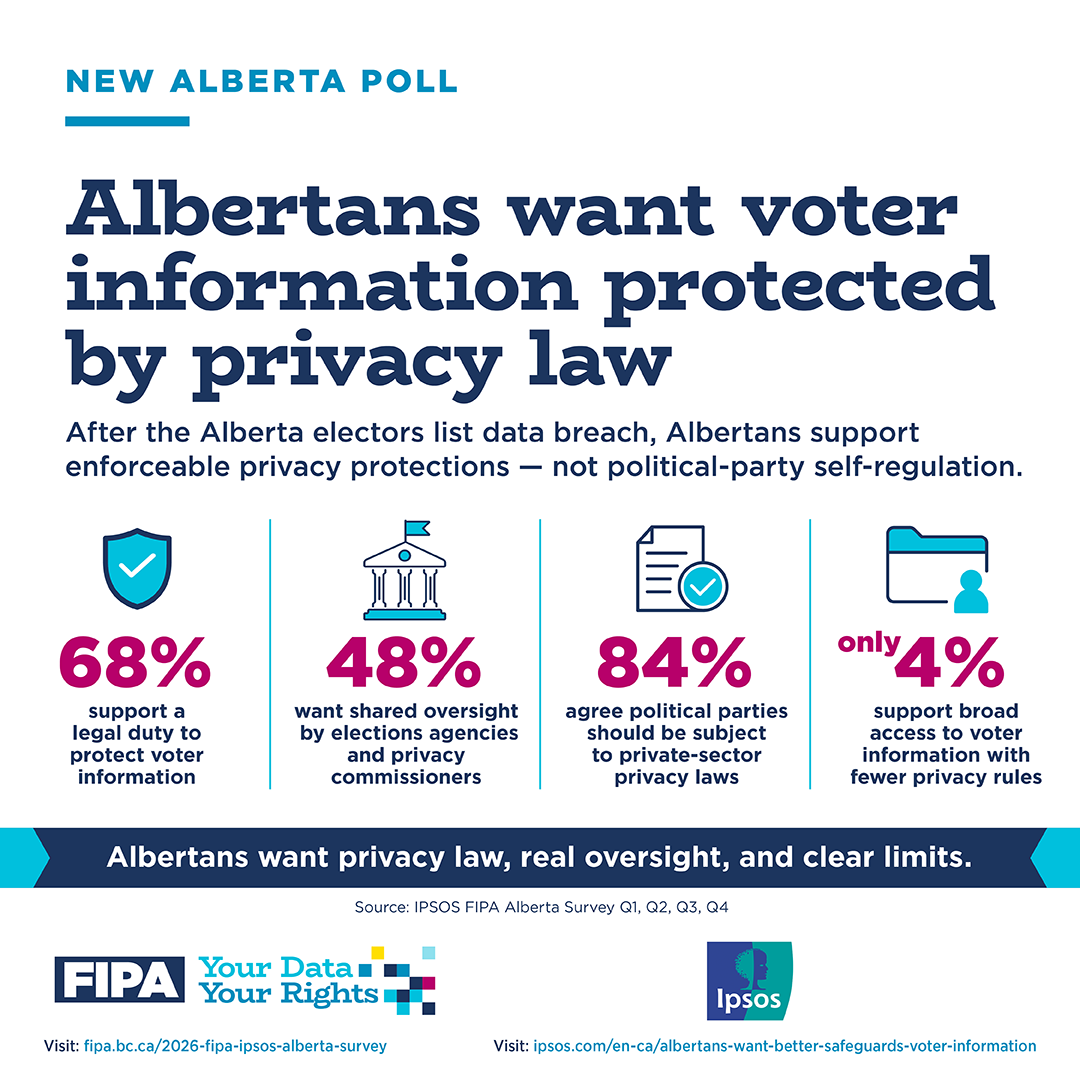
84% agree
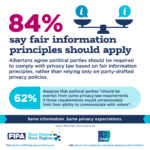
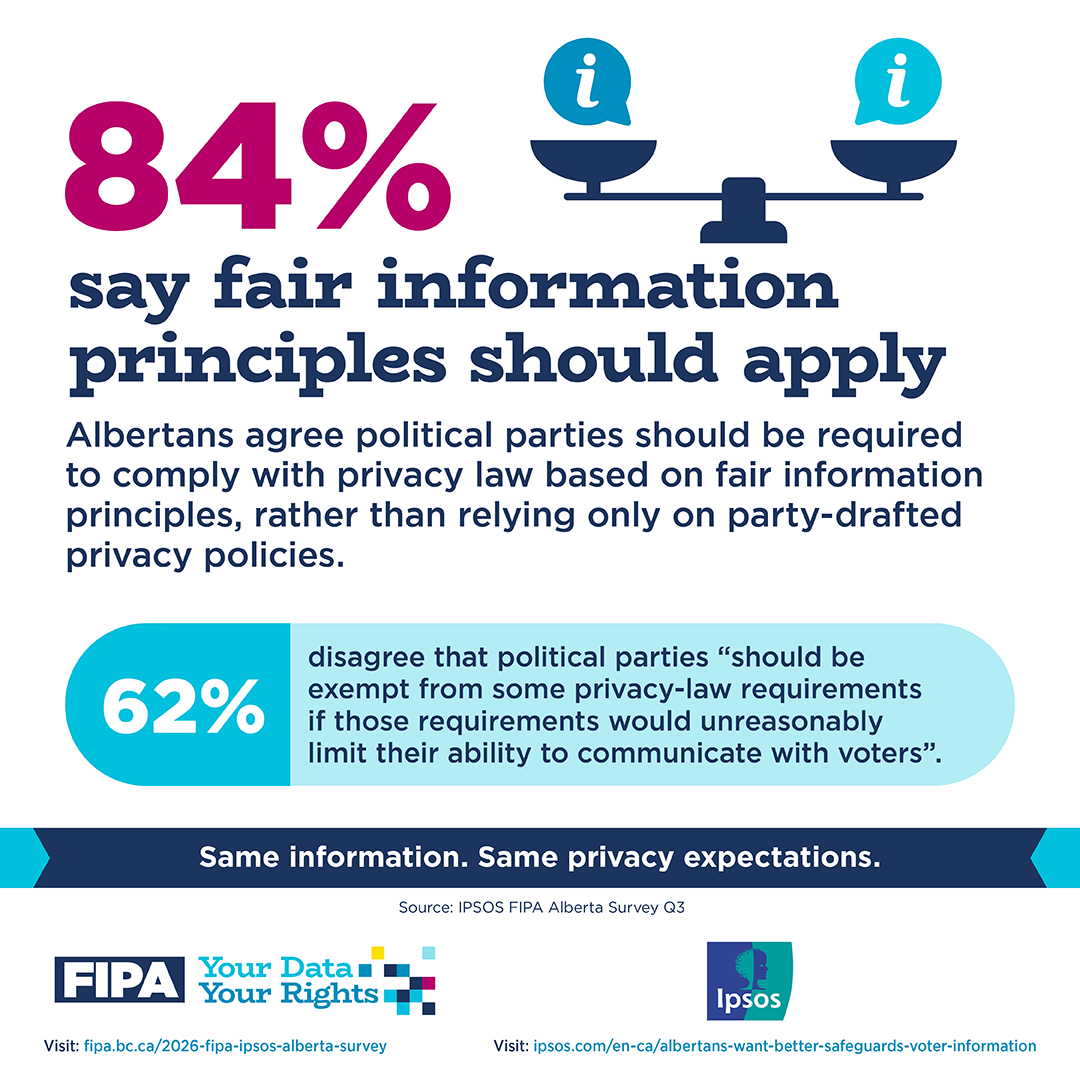
Political actors should comply with privacy law based on fair information principles rather than relying only on party-drafted privacy policies.
84% agree
A legal duty should protect voter information against unauthorized access, sharing, copying, or misuse.
68% support
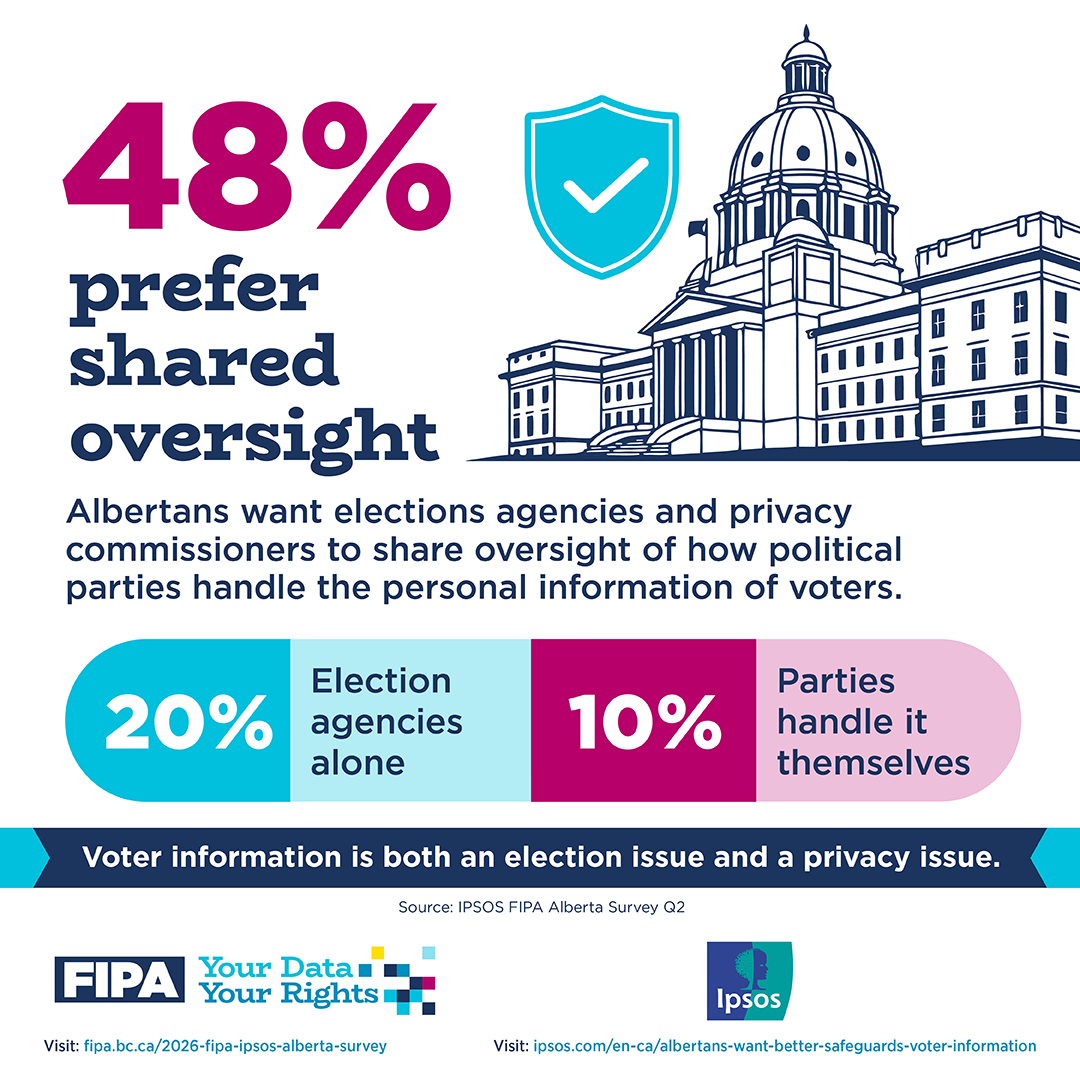
Elections agencies and privacy commissioners should share oversight after breach, misuse, or unauthorized sharing.
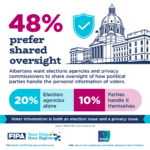
48% prefer
Political actors should rely on their own published privacy policies instead of privacy legislation.
66% disagree
Broad political access with fewer privacy rules is not the preferred balance.
Only 4%
1 Albertans want legal safeguards for voter information
The poll asked Albertans what safeguards should be required by law when political parties, candidates, campaign organizations, or their agents collect, use, share, or retain voter information. Only 2% say none of the tested safeguards should be required by law.
68% support a legal duty to protect voter information against unauthorized access, sharing, copying, or misuse.
63% support a legal duty to notify affected individuals and the appropriate regulator when voter information is breached or misused.
63% support penalties or other enforcement consequences for serious misuse, unauthorized sharing, or failure to protect voter information.
54% support a right to request correction of inaccurate personal information held for political purposes.
54% support a right to request deletion or withdrawal of consent where the information is no longer needed for an authorized purpose.
51% support a right to access personal information held about them for political purposes.
50% support a legal duty to limit voter information to authorized electoral or democratic purposes.
When asked what oversight approach should apply if voter information held or used by political parties or campaign organizations is breached, misused, or shared without authorization, the leading response is shared oversight by elections agencies and privacy commissioners.
48% say elections agencies and privacy commissioners should share oversight, with clear authority to investigate, order corrective action, and refer serious cases for penalties.
20% prefer elections agencies alone because the information is connected to elections.
10% say political parties and campaign organizations should investigate and resolve these matters themselves under their own published privacy policies.
5% say political parties and campaign organizations should not be subject to external oversight requirements because they need to communicate with voters and participate in elections.
The finding matters because the Alberta List of Electors incident exposed the gap between election administration and privacy protection. The public does not appear to see voter information solely as an election-administration issue; it is also a privacy-rights issue.
Elections Alberta in their May 1, 2026 release has said that, as Alberta’s legislation is currently written, it cannot prevent unauthorized distribution or use of a List of Electors once it has been provided to a registered political party or other authorized entity.
3 Strong support for fair information principles and privacy law
The clearest policy finding is that Albertans want political actors to follow privacy-law standards, including established fair information principles: accountability, consent, safeguards, access rights, correction rights, and limits on collection, use, disclosure, and retention. Canadian information principles extend back to 1996 with CAN/CSA-Q830-96Model Code for the Protection of Personal Information. They are most recently evident in PIPEDA fair information principles.
84% agree that political parties, candidates, campaign organizations, and their agents should be subject to the same private-sector privacy laws that apply to other organizations.
84% agree that political actors should comply with privacy law based on fair information principles, rather than relying only on party-drafted privacy policies.
68% agree that political actors should be subject to a specific privacy law designed for political parties and campaign organizations.
66% disagree that political actors should be allowed to rely on their own published privacy policies instead of being subject to privacy legislation.
62% disagree that political actors should be exempt from some privacy-law requirements if those requirements would unreasonably limit their ability to communicate with voters.
4 Albertans favour limits, consent, and election-purpose restrictions over broad access
Albertans were asked which statement comes closest to their view about balancing political communication and privacy protections. The top four responses all involve limits on when and how political parties and candidates may use voter information.
27% say political parties and candidates should not be allowed to collect, use, or retain personal information about voters outside official election periods.
25% say political parties and candidates should only be allowed to use voter information where individuals have given consent.
19% say political parties and candidates should have access to voter information for authorized election purposes only, with clear legal limits, security duties, and privacy duties.
10% say political parties and candidates should be allowed to use voter information during and between elections, but only for clearly defined political purposes and with privacy safeguards.
Only 4% say political parties and candidates need broad access to voter information to communicate with people and support democratic participation, even if this means fewer privacy rules.
Only 33% of Canadians trust federal political parties to protect personal information.
80% agree federal political parties should follow the same privacy rules as businesses and public sector organizations.
84% agree Canadians should have the right to access their personal information held by federal political parties.
83% agree federal political parties should face significant penalties if data breaches or misuse of personal information occurs.
Together, the Alberta and federal results point in the same direction: Canadians do not want political parties to be carved out of ordinary privacy accountability.
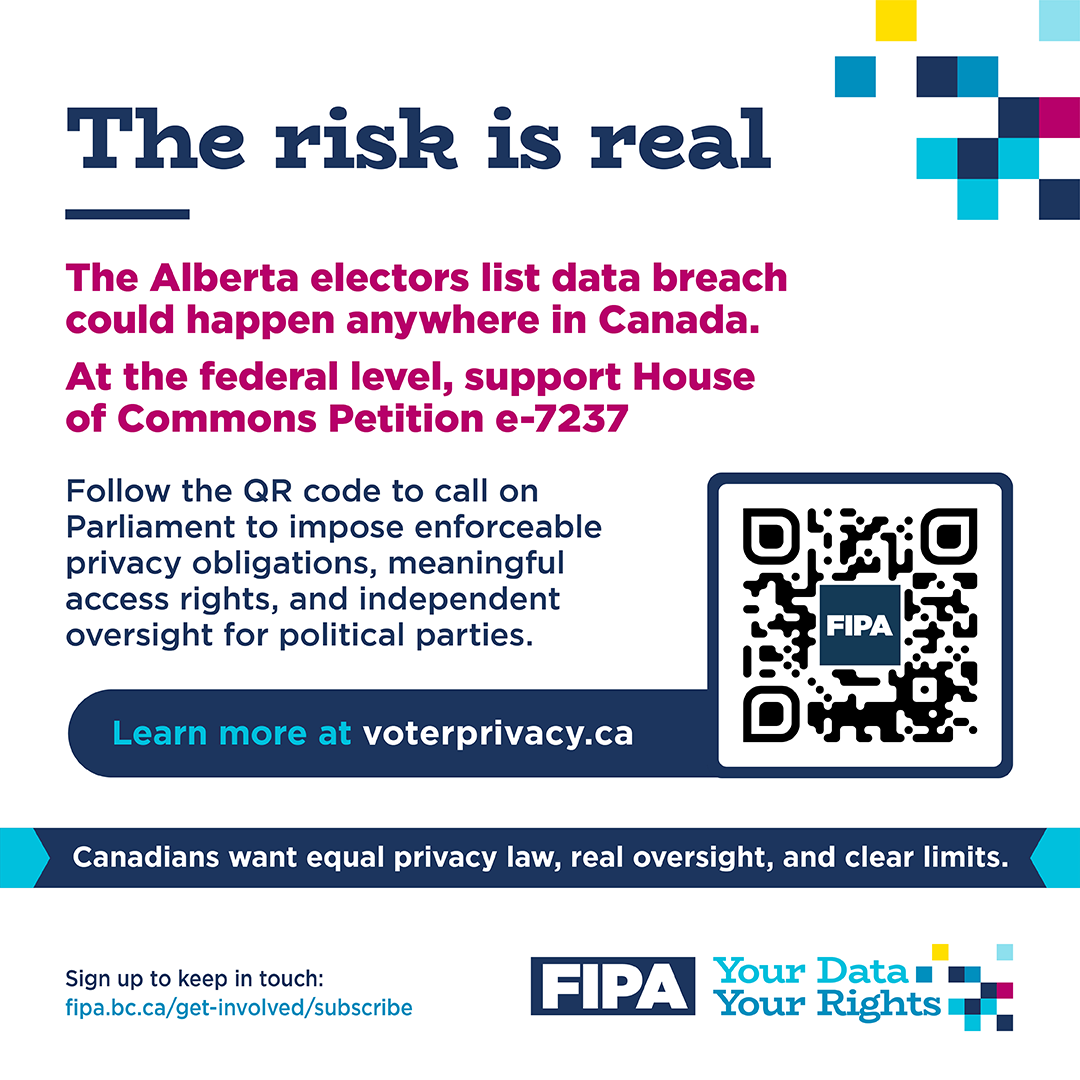
FIPA and partners launched VoterPrivacy.ca to help Canadians understand how political parties collect and use personal information, and to encourage people to support stronger privacy protections.
That work includes House of Commons Petition E-7237 authorized by Green Party MP Elizabeth May. The Federal New Democratic Party, Liberals and Conservatives have stood united and launched legal battles to avoid being subject to Canadian Privacy Laws. They recently passed retroactive legislation in an effort to avoid potential court rulings on the matter. This petition calls on Parliament to oppose or repeal measures that exempt federal political parties from privacy obligations and to impose enforceable privacy obligations equivalent to widely accepted Canadian fair information principles, including meaningful access rights and independent oversight, before the next federal general election.
FIPA is encouraging anyone who wants better privacy protections from political parties to sign House of Commons Petition e-7237.
Why this matters
Voter information can include names, addresses, contact details, and other data that may expose people to risk if misused or shared without authorization. Elections Alberta has said it heard from Albertans who were “unhappy, scared, and anxious” about the unauthorized use of the List of Electors, including people who face heightened risks if their information becomes public. The BC OIPC’s Investigation Report P19-01 exposes the extent of personal information collected by federal political parties.
The issue is not whether political parties should be able to communicate with voters. The issue is whether political actors should be allowed to collect, use, retain, and share personal information without the same privacy expectations that apply elsewhere in Canadian society.
The Alberta polling answers that question. Albertans want:
enforceable privacy law;
fair information principles;
access and correction rights;
limits on collection, use, disclosure, and retention;
breach notification;
penalties for serious misuse; and
oversight that includes privacy commissioners.
The Alberta List of Electors incident has made a long-standing privacy problem impossible to ignore and reflects federal findings.
Political parties and campaign organizations increasingly rely on data to identify, profile, target, and communicate with voters. But public trust depends on clear rules. Democratic participation is not strengthened when personal information is exposed to misuse. It is strengthened when political actors are accountable under enforceable privacy law.
The polling shows that Albertans and Canadians understand this.
Voter privacy cannot depend on political parties policing themselves. Privacy protection must follow voter information wherever it goes.
The next few questions are about how political parties, candidates, campaign organizations, and their agents collect, use, share, retain, and protect voter information.
In Alberta, Elections Alberta has stated that there was an alleged unauthorized use and/or distribution of the provincial List of Electors. The incident has raised questions about how voter information is protected once it is provided to political participants and subsequently used for political purposes.
These questions are about what safeguards Albertans think should apply when voter information is collected, used, shared, or retained for political purposes.
Q1 Legislative remedies: required safeguards
Which of the following safeguards do you think should be required by law when political parties, candidates, campaign organizations, or their agents collect, use, share, or retain voter information? Please select all that apply. [RANDOMIZED]
Response option
Result
A legal duty to protect voter information against unauthorized access, sharing, copying, or misuse.
68%
A legal duty to notify affected individuals and the appropriate regulator when voter information is breached or misused.
63%
Penalties or other enforcement consequences for serious misuse, unauthorized sharing, or failure to protect voter information.
63%
A legal right for individuals to request correction of inaccurate personal information held for political purposes.
54%
A legal right for individuals to request deletion or withdrawal of consent where the information is no longer needed for an authorized purpose.
54%
A legal right for individuals to access personal information held about them for political purposes.
51%
A legal duty to limit voter information to authorized electoral or democratic purposes.
50%
Independent oversight by a privacy commissioner.
43%
None of these should be required by law
2%
Not sure
8%
Q2 Oversight model after a breach or misuse
If voter information held or used by political parties or campaign organizations is breached, misused, or shared without authorization, which of the following oversight approaches do you think should apply? Please select one. [RANDOMIZED]
Response option
Result
Elections agencies and privacy commissioners should share oversight of political parties and campaign organizations’ use of voter information, with clear authority to investigate, order corrective action, and refer serious cases for penalties.
48%
Elections agencies should be solely responsible for overseeing political parties and campaign organizations’ use of voter information because the information is connected to elections.
20%
Political parties and campaign organizations should be responsible for investigating and resolving these matters themselves under their own published privacy policies.
10%
Political parties and campaign organizations should not be subject to external oversight requirements because they need to communicate with voters and participate in elections.
5%
Not sure
17%
Q3 Privacy law requirements
Privacy laws such as Alberta’s and British Columbia’s Personal Information Protection Acts apply to many private-sector organizations. These laws are based on common fair information principles, including accountability, consent, safeguards, access rights, correction rights, and limits on collection, use, disclosure, and retention.
How strongly do you agree or disagree with each of the following requirements for political parties, candidates, campaign organizations, and their agents when they collect, use, share, or retain voter information? [RANDOMIZED] Scale: Strongly agree, somewhat agree, somewhat disagree, strongly disagree, don’t know
Requirement
Agree
Disagree
They should be subject to the same private-sector privacy laws that apply to other organizations.
84%
9%
They should be required to comply with privacy law based on fair information principles, rather than relying only on party-drafted privacy policies.
84%
9%
They should be subject to a specific privacy law designed for political parties and campaign organizations.
68%
22%
They should be allowed to rely on their own published privacy policies instead of being subject to privacy legislation.
24%
66%
They should be exempt from some privacy-law requirements if those requirements would unreasonably limit their ability to communicate with voters.
26%
62%
They should be subject to the same private-sector privacy laws that apply to other organizations.
Top 2 Box(Net)
84%
Bottom 2 Box (Net)
9%
Strongly agree
49%
Somewhat disagree
6%
Somewhat agree
35%
Strongly disagree
3%
Don’t know
7%
They should be required to comply with privacy law based on fair information principles, rather than relying only on party-drafted privacy policies.
Top 2 Box (Net)
84%
Bottom 2 Box (Net)
9%
Strongly agree
51%
Somewhat disagree
6%
Somewhat agree
33%
Strongly disagree
3%
Don’t know
7%
They should be subject to a specific privacy law designed for political parties and campaign organizations.
Top 2 Box (Net)
68%
Bottom 2 Box (Net)
22%
Strongly agree
29%
Somewhat disagree
14%
Somewhat agree
39%
Strongly disagree
8%
Don’t know
11%
They should be allowed to rely on their own published privacy policies instead of being subject to privacy legislation.
Top 2 Box (Net)
24%
Bottom 2 Box (Net)
66%
Strongly agree
8%
Somewhat disagree
21%
Somewhat agree
16%
Strongly disagree
45%
Don’t know
10%
They should be exempt from some privacy-law requirements if those requirements would unreasonably limit their ability to communicate with voters.
Top 2 Box (Net)
26%
Bottom 2 Box (Net)
62%
Strongly agree
7%
Somewhat disagree
24%
Somewhat agree
19%
Strongly disagree
38%
Don’t know
12%
Q4 Balancing democratic communication and privacy rights
Which statement comes closest to your view about balancing political communication and privacy protections? Please select one. [RANDOMIZED]
Response option
Result
No collection, use, or retention outside official election periods
27%
Use only where individuals have given consent
25%
Access for authorized election purposes only, with clear legal limits, security and privacy duties
19%
Use during and between elections, but only for clearly defined political purposes with safeguards
10%
Broad access, even if this means fewer privacy rules
4%
None of these
6%
Not sure
8%
About the Study
These are the findings of an Ipsos poll conducted between May 22 and 26, 2026, on behalf of the BC Freedom of Information and Privacy Association (FIPA). For this survey, a sample of 801 Canadians aged 18+ was interviewed online. These data were statistically weighted by region, age, gender and education to ensure the sample composition reflects that of the actual Alberta population according to Census data. The precision of Ipsos polls containing online data is measured using a credibility interval. In this case, the overall poll is accurate to within +/ -4.2 percentage points, 19 times out of 20, had all adult Alberta residents been polled. The credibility interval will be wider among subsets of the population. All sample surveys and polls may be subject to other sources of error, including, but not limited to coverage error, and measurement error.