
BC Freedom of Information and Privacy Association
Your Data Your Rights
A family’s routine evening walk ended on Friday, Aug. 7, 2026, with a family dog fatally injured, two children saying goodbye to that pet at an emergency veterinary clinic, and a Kingston mother trying to determine who was responsible for responding to a dog she believed could remain a danger to her neighbourhood.
Four days later, Lia De Pauw took those questions directly to Kingston City Council at its meeting on Tuesday, Aug. 11, 2026.
“When we make children’s safety the priority, and when we make children’s rights something that we take seriously, our communities are safe for everyone,” De Pauw told councillors.
De Pauw had been permitted to make a late delegation as Council considered a report on Kingston’s application for up to $1.32 million over three years from the federal Building Safer Communities Fund.
But she told Council that creating safer communities requires more than programs and funding.
“Children’s safety and well-being is not about a program. It’s not about an educational campaign,” she said. “It’s about decisions that the Council makes every day. It’s about decisions that your staff make every day.”
For De Pauw, those decisions became painfully real Friday night.
Three little dogs
De Pauw and her two sons had two dogs of their own.
Toffee is a 20-pound Australian labradoodle. Bamse, a 10-month-old miniature dachshund, joined them last year after the family regularly dog-sat another dachshund, Juniper, and fell in love with the breed.
Juniper belongs to De Pauw’s friend but stays with the family regularly. Bamse and Juniper became best friends.
At about 8:45 p.m. on Friday, August 7, De Pauw gathered all three dogs for their usual evening walk.
About five minutes later, as they passed 255 Yonge Street, De Pauw said she suddenly saw a large black dog charging toward them.
She began screaming for someone to get the dog.
According to a detailed chronology De Pauw provided to Kingstonist, the black dog grabbed Bamse around her upper body and began shaking her.
A man who De Pauw said had care of the large dog grabbed it, causing it to release Bamse.
Bamse was bleeding extensively and screaming in pain.
De Pauw picked Bamse up and ran home, where she woke her six-year-old son and asked her 12-year-old to help hold the injured dog while she figured out how to get Bamse to emergency veterinary care.
The children went with her to the emergency veterinary clinic, where Bamse was given pain medication and oxygen. However, De Pauw said X-rays showed multiple broken ribs and internal bleeding, and the family was told the dog’s injuries were not survivable.
Her sons were given an opportunity to say goodbye. Her older son chose to remain with Bamse during the euthanasia procedure while De Pauw comforted her younger child, who had become frightened and left the room.
The family returned home at approximately 10:30 p.m.
De Pauw put their blood-stained clothing into plastic bags in case it was needed as evidence.
Then she called police.
‘They would not come’
“When I got home from the vet, the first thing I did after I helped my children clean up was I called the police,” De Pauw told Council.
De Pauw said she called Kingston Police at approximately 11:25 p.m. and reported what had happened. However, she said she was told police only respond to dog attacks when a person has been bitten.
“The police told me they could not come because the dog had not bit me, but had killed my dog. They would not come,” she said.
De Pauw said she was directed toward municipal enforcement, but did not receive an immediate response.
The next morning, she began researching Ontario’s Dog Owners’ Liability Act (DOLA).
She called Kingston Police again shortly before 8 a.m. and questioned the advice she had received the night before.
“I realized that there’s the Dog Owners’ Liability Act, and the police should have done something,” she told Council. “I called the police back. I spoke with a staff sergeant. They started the process.”
Kingston Police confirmed to Kingstonist that officers subsequently attended and spoke with the parties involved.
“Relevant information was gathered by the attending officers and documented in a report,” Constable Anthony Colangeli, Kingston Police media relations officer, said.
“The report was prepared for By-Law [Enforcement] with respect to the Dog Owners’ Liability Act of Ontario.”
Police did not answer Kingstonist’s question about whether De Pauw was initially told officers would only respond if a person had been bitten, whether that advice was correct, or what responsibilities police have under DOLA when a dog attacks another domestic animal but not a person.
DOLA applies to attacks on animals
Ontario’s Dog Owners’ Liability Act is not limited to attacks on humans.
The legislation provides for proceedings where a dog has bitten or attacked a person or domestic animal, and its definition of an owner extends beyond a registered owner to include someone who possesses or harbours the dog.
Where a court finds that a dog attacked a person or domestic animal, it can order measures intended to protect the public, including confinement, leashing, or muzzling, and in some circumstances can order that the dog be destroyed.
Factors a court may consider include the seriousness of the injuries caused, the dog’s temperament, the likelihood of another attack, its physical capacity to inflict harm, and precautions subsequently taken by its owner.
The legislation contains stricter provisions for dogs found to meet its statutory definition of a pit bull. If a court finds that a dog is a pit bull under the act and that it attacked a person or domestic animal, DOLA requires the court to order the dog destroyed.
De Pauw described the attacking dog as a pit bull-Bullmastiff cross. Kingstonist has not independently established the dog’s breed, and the City has not said whether it is considering DOLA’s restricted-pit-bull provisions.
City confirms investigation, but little else
De Pauw continued trying to get a response Saturday.
She submitted a written bylaw complaint at 7:20 a.m. and contacted the City’s after-hours service.
At approximately 1 p.m., she received a call from a City enforcement supervisor and says she was told bylaw had taken over the investigation from police.
On Sunday, enforcement officers interviewed De Pauw and took a written statement. According to De Pauw, those officers told her they were not the City’s regular Animal Control officers and were gathering information that would be passed to that team.
The City has confirmed an investigation is underway.
“Municipal Enforcement is aware of the incident and is actively reviewing the circumstances,” the City of Kingston’s Communications Department Pye told Kingstonist.
“As with any dog-related investigation, staff consider the applicable requirements and authorities under Ontario’s Dog Owners’ Liability Act and the City of Kingston Animal By-law to determine what, if any, enforcement action is appropriate.”
But the City declined to answer Kingstonist’s questions about whether authorities have located the dog, where it is now, whether a muzzle or leash order was issued, whether seizure was considered, whether charges are under consideration, or whether officials contacted Ottawa after being told the dog normally resides there.
“As this is an active enforcement matter and involves information protected under privacy legislation, we are unable to provide further details,” the municipality said.
The City also did not answer general questions about what factors determine whether a dog is seized following a serious attack, whether the severity of another animal’s injuries is considered, whether an owner’s or handler’s remorse factors into enforcement decisions, or what Animal Control coverage exists outside regular working hours.
Kingstonist subsequently sent the City a narrower set of followup questions, including whether officials could confirm, without identifying anyone, that they know the dog’s current whereabouts and are satisfied measures are in place to prevent it from posing a further risk to people or animals.
The City was also asked to clarify its general policies concerning seizure following a serious attack and after-hours Animal Control coverage.
No response to those followup questions had been received by publication time.
Questions about 255 Yonge Street
De Pauw’s concerns also extend to 255 Yonge Street, the City-owned housing property from which she says the attacking dog emerged. Operated by Tipi Moza, an Indigenous housing provider in Kingston, the triplex offers permanent affordable units for Indigenous families, including women and children.
Kingstonist is not identifying the man De Pauw says had care of the dog at the time of the attack.
De Pauw said he is the adult son of a woman who lives at the Tipi Moza property and described him as a frequent, long-term guest there.
According to De Pauw, the man was outside with the dog when it charged toward her and the three smaller dogs. She said he ultimately grabbed the larger dog, causing it to release Bamse.
De Pauw attempted to contact Tipi Moza shortly before midnight on the night of the attack.
On Monday, she received an email from the organization asking for information establishing whether its tenant was connected to the incident.
De Pauw responded with the name of the man she says had care of the dog, identified him as the adult son and long-term guest of a woman who lives at the property, and provided the names of the City enforcement officers investigating the attack.
Juniper’s owner, who also lives in the neighbourhood (and will not be named for privacy reasons), separately told Kingstonist that the man is regularly present at the property. He said his understanding is also that the man’s mother lives there, although he acknowledged that some of what he knows about the man’s living arrangement has come from other neighbours.
That distinction matters because 255 Yonge Street is intended to provide housing for families.
Both the mini dachshund owners are questioning what rules apply to long-term guests and animals brought onto the property and who is responsible for ensuring those rules are followed.
Juniper’s owner emphasized that his concern is not with social or supportive housing itself.
Rather, he questions whether publicly funded housing in an established neighbourhood is accompanied by sufficient support and oversight — including whether the organization responsible for the property knows who is regularly staying there and responds when serious safety concerns arise.
Kingstonist asked Tipi Moza to clarify the man’s status at 255 Yonge Street, what policies govern long-term guests and animals at the property, and what responsibility the organization has for enforcing those rules.
Tipi Moza had not responded to Kingstonist’s questions by publication time.
Kingstonist also asked the City what oversight it exercises over safety, guests, and animals at a City-owned property operated by a third-party housing provider. No response to those questions had been received by publication time.
‘Think about… what could have happened to a child’
For De Pauw, those questions extend beyond what happened to Bamse.
She told Council she lives in a mixed-income neighbourhood experiencing significant social and material deprivation and that children routinely travel the same street on bicycles and scooters, in strollers, and on foot.
“Children deserve to be safe in their neighbourhood,” she said.
That was why De Pauw brought the attack to Council as it considered the Building Safer Communities Fund.
The federal program is intended to support community safety and violence-prevention initiatives, with Kingston eligible to receive up to $1.321 million between 2026 and 2029.
City staff’s report to Council said the funding could support a “coordinated and community informed approach” to improving safety, inclusion and well-being for youth and families.
De Pauw told councillors those goals also have to be reflected in everyday decisions about policies, enforcement, and how government responds when residents raise safety concerns.
“Think about children and what could have happened to a child if that dog that killed my dachshund for no reason had gone after a child instead, on a scooter or a bike,” she said.
When De Pauw finished her delegation, Mayor Bryan Paterson asked members of Council whether they had any questions.
None did.
And as Juniper’s owner pointed out, the damages done by the attack are not limited to just the trauma and concern of those involved — the veterinary costs incurred with Bamse’s treatment and euthanasia are well into the thousands.
Kingstonist sent followup questions to Tipi Moza and The City of Kingston. We will present response as it become available.
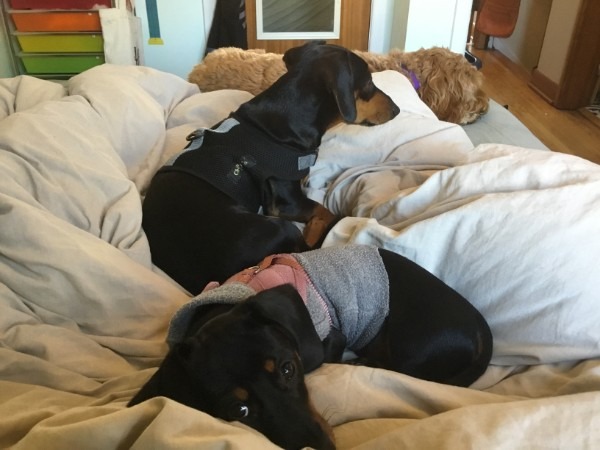
Three pals. Top to bottom are Toffee, Juniper and Bamse.
You can support trusted and verified news content like this.
FIPA’s news monitor subscribers, donors and funders help make these available to everyone rather than behind a paywall. We appreciate every contribution because it makes a difference.
If you found this article interesting and useful, please consider contributing here.
